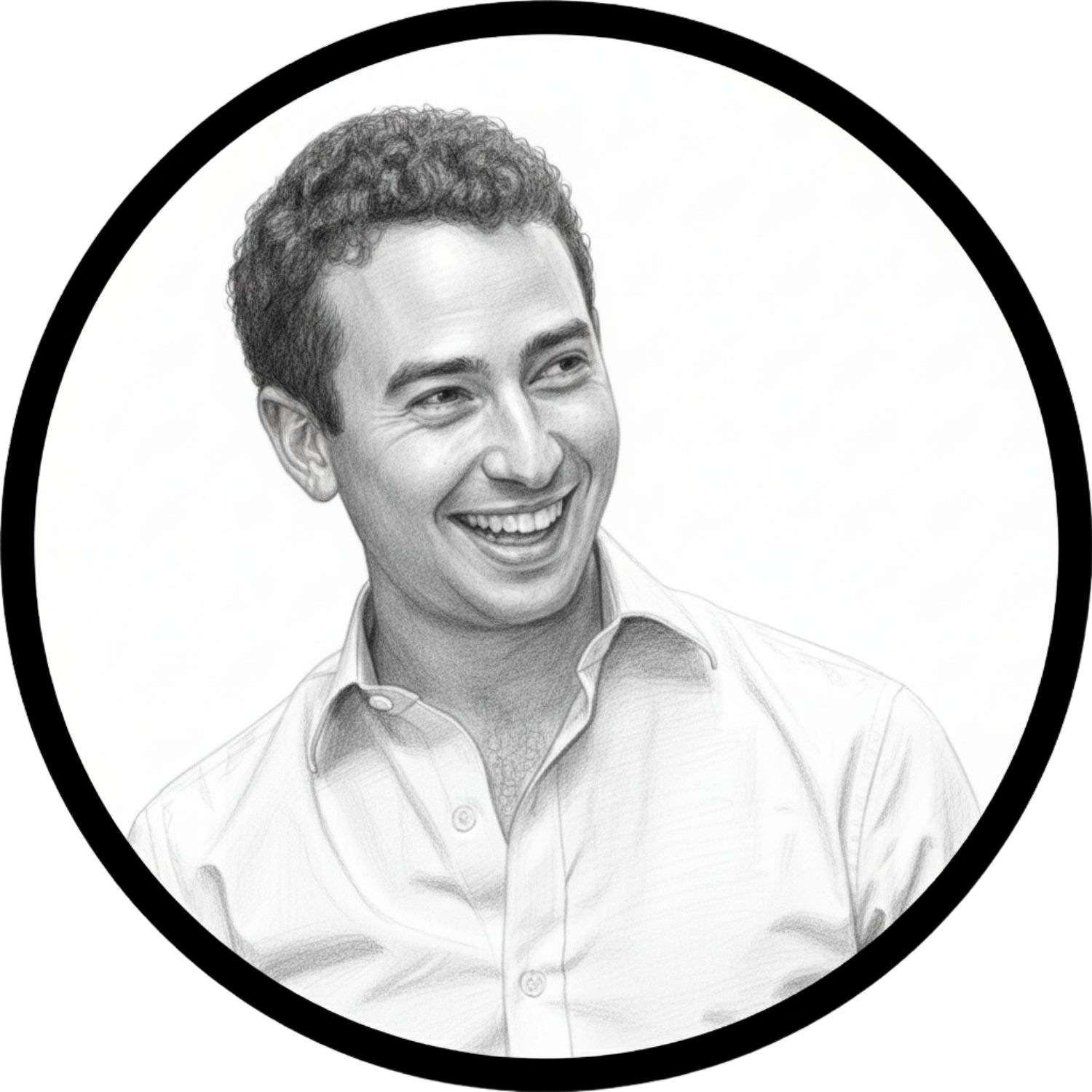
Founder Spotlight: Khaled Kteily
Co-founder and CEO of Legacy

The Nickname
Mike: Khaled, hey, thank you so much for taking the time. Let me start by saying you have the most unique and maybe best nickname out of anyone I've met so far.
Khaled: Sure, sure.
Mike: Do you want to mention the nickname?
Khaled: Spermking.com, baby. My friends have been calling me that for the last 10 years. That URL takes you straight to my LinkedIn.
Mike: I mean, it's an interesting URL. It could go to a lot of different places. But why don't we kind of start there? It's been a 10-year journey for you. Why don't we just kind of start from the beginning? What are you building?
The Origin Story
Khaled: So I run a mail fertility company called Legacy. We help men test and freeze their sperm from home. We developed a mail-in kit that looks more or less like this. You order online, you get it at home. You do your thing from home. We have some very simple instructions to help you get started. And then when you're done, we have a sperm preservative. It's a liquid that you add to the sperm sample, keeps it alive for up to 72 hours. And we conduct a full clinic-grade semen analysis. We will test it for you and we will freeze it for you. So we do more sperm freezing than anyone in the country. We've raised about $50 million from VCs — Bain Capital, First Mark, Section 32. We went through YC in Summer 19. I know you are also doing things that don't scale. And we have been in business for about eight years now since we founded it out of Harvard in 2018.
Mike: I love how you include instructions for something that men have been doing since the beginning of time.
Khaled: You would be surprised. You would be surprised. People overthink the process sometimes. And some people just really like to get all the details.
Mike: Your help desk tickets must be very interesting. But Khaled, tell me about the beginning. How did you come up with this idea? How did you become the sperm king?
Khaled: I mean, it was a nickname many years in the making, but I had an accident maybe a decade ago, actually a little bit more at this point, where I spilled scalding hot tea and scalding hot coffee on my lap. So I got second degree burns. I was hospitalized. Very painful. Thankfully, everything healed up, but it took a month and a half to heal. And during that time, I was not even able to wear normal jeans. So quite painful. Anyone who has an experience like that is just going to be thinking, thank God that wasn't worse, right? That could have gone down a bad path. And it got me thinking a lot because I've always wanted to be a dad. I've always seen myself as a husband and a father. And that accident kind of put everything into sharp relief for me, like, wow, things could have gone a different direction. So I was living in Cambridge, Massachusetts at the time. I looked up local sperm bank in Cambridge, Mass. Funnily enough, that same sperm bank emailed us a few years ago asking if we wanted to buy that facility. I'm like, wow, the world has truly come full circle. But the process of producing a sperm sample at a sperm bank or a fertility clinic is so unbelievably awkward. They hand you the cup. They take you to this room. You don't want to touch anything in that room. You can hear everything going on outside because it's a normal work day for them. You're there with the cup. In my case, they were running behind and asked if I could speed up the process because there was someone coming in about 10 minutes. And you do your thing. It's under duress. You hand them the cup. You spend a week until you get your results worrying about what your life will look like if you're infertile. So I went through it. I paid about a thousand dollars to do that. And I became so fixated on this idea. Okay, well, every guy thinks about having kids. Most men, like most women, ultimately do want to have a family. You need good, healthy sperm in order to have a family. You need to know if you have good, healthy sperm in order to have that family. And so what if you had a product that was from home, that was affordable, that was branded the right way, that was no doctors or clinics necessary. All you have to do is masturbate at home. You just have to masturbate at home one time and you can preserve your ability to have kids for the rest of your life. And by the way, the cost to do so — our lowest priced semen analysis — is one hundred and forty five dollars.
A Shared Experience
Mike: So, Khaled, we're going to get to know each other on this conversation. I don't know if this will make the full episode, but my wife and I, we did IVF.
Khaled: Sure, super fun.
Mike: So my experience was similar to what you mentioned. I walked into a hospital. Of course, it's a female nurse in the beginning. They take me into a room. I specifically remember the room they had set up had like a 50 inch screen monitor. And you don't want to touch the remote because you know some guys have just been doing it in there. I remember this because the computer was set up, and it was so funny because there was only one icon on the screen. And it was a link to Pornhub. And I remember thinking, guys, I don't need help with this one. You know?
Khaled: I've heard of this one.
Mike: But then, similar to you, the nurse kind of tells me beforehand, she's like, hey, there's a line, whatever. But in my head, I didn't want to be too fast. If you walk out one minute later, you're like, oh.
Khaled: There's a lot of things going through your head at the time.
Mike: So me being the guy that I am, I start browsing TikTok. And then, as you do on TikTok, like 15 minutes go by and now I realize I've been in there a very long time. Like a creepily long time. Anyway, so the way you describe it, it's a very awkward situation and it really resonates with me. But Khaled, I'm curious. You had this idea when you were in business school, in undergrad?
Khaled: So I had the idea, actually, when I was at Harvard, but I'm not Mark Zuckerberg. I wasn't going to drop out and give up a beautiful Harvard degree to pursue this crazy idea where I had no background, no prior entrepreneurial experience. I had no friends who were entrepreneurs. I had never done this before. Even by my standards, and I'm definitely on the crazy scale, that felt too crazy. And so I figured, let me do it when the time is right and certainly after I've gotten my degree.
Taking the Leap
Mike: Got it. So tell me about the early days. I mean, there's HIPAA, this is health care. What were your first steps? How did someone who didn't think they were going to be a founder end up building this and becoming this sperm king?
Khaled: I always find it interesting. I've met a lot of people these days who want to be founders in search of a company to start. They've decided they want to be a founder, right, and they're kind of backing into it. For me it was very much like I identified a very obvious problem with a solution that I thought was 10X better than what existed. And I kind of reached this conclusion only because it was, if I don't do this, I'm an idiot, because this is such a good idea and such an obvious thing to do. And the scary part for any founder or entrepreneur is that moment where you have to take the leap of faith. So I actually didn't start Legacy right after my master's. I actually went to work at the World Economic Forum in Geneva, Switzerland for a couple of years. The idea kept gnawing away at the back of my head. This big study comes out mid 2017 talking about how sperm counts had gone down 50 to 60 percent in the past 40 years. And I said, oh, my God, I can't put this off anymore. I need to do this. And it requires you to take the leap of faith. You have to sit down, tell your boss you're quitting, give up a nice salary, a cushy job. I left Switzerland, I moved to Boston, everything was new. And in that moment, it's scary, but you have no other choice. One day I remember I woke up, I'm on my laptop and I was like, all right, well, I am now the founder, CEO of Legacy. CEO is a joke title because I am a company of one. All my early emails say 'we,' right — 'we took a look at the proposal.' Yeah, me. Nowadays, at least you and Claude, that's kind of believable, but back in my day it was just me. And I had to register us with the FDA. I had to go through all of HIPAA. I had spent years taking training modules around sperm. I wasn't that worried about it, but I had to fly all over the world building out an advisory board. As a Canadian, I also had to go through the visa process, which is a nightmare in the U.S., as anyone who's gone through it knows. I had to think about funding. I mean, at that time, I had $17,000 in a pension plan in Switzerland that I withdrew.
Mike: Wow. $17,000.
Khaled: I raised a little bit of angel investment money. It wasn't a ton. And so I had to think about funding early on. You're just doing everything all the time, all at once, but there is no other way to do it.
Mike: Wow. So it was that study. Was it that day? And when did you quit? Walk me through the decision process.
Khaled: A few months later, I sat down with my boss. So I immediately was like, okay, this is it. The idea had been germinating for a while. Officially, I hired a designer, mocked up a landing page, put up some products, figured out how I wanted to do this, talked to enough friends who were potentially interested in putting money in. But I felt like, okay, it's time for me to do this. And that was it. A few months later, I sat down with my boss. And I said, hey, I'm leaving to start a sperm company. And he's like, what? I'm like, yeah, yeah, don't worry about it. He's a wonderful, wonderful person. I think after the initial shock wore off, he was very supportive. And it really was that simple. You sit them down. You send in your letter of resignation. A couple of weeks later, I quit my job. I had moved to Boston. I had started my company.
Mike: Starting a sperm company is usually the most common logical step after the World Economic Forum. I'm sure your boss has had that conversation a number of times.
Khaled: Correct.
Mike: I'm curious. What gave you the confidence to say you're going to solve this problem? What makes you confident? Like you just listed a 500 point list of things that you had to do — advisors, FDA, set up the website.
Khaled: So I remember I actually gave a presentation as part of this program at the World Economic Forum called the Leadership Fellows. And it was maybe 20 of us that had been going through this leadership training. I gave a presentation to all of them before I officially left on exactly what it was that I was going to be doing. I sat down with the founder of the World Economic Forum, Professor Klaus Schwab, and I explained what I was building. Without fail, every single one of them thought I was absolutely bananas. And the quote that I think is the most appropriate and apt quote is, we do this not because it is easy, but because we thought it would be easy. In the moment you're kind of like, yeah, sure, this is so obvious. How could this not be a billion dollar business in a couple of years, right? Then obviously you start and you realize that everything is much harder, much more complicated. But by that point, it's the sunk cost fallacy. You're locked in.
Why Sperm Counts Are Falling
Mike: Right. Separate question. You mentioned that sperm count has been going down. I had seen that. What's causing that? Do you guys help with that?
Khaled: Yeah. There's a lot to unpack in that statement. So the simplistic quote, which is largely accurate, is that sperm counts have declined 50 to 60 percent over the past 40 years. So that means when your father or maybe your grandfather was your age, he was twice as fertile, right? The same is also true of things like testosterone levels that are also going down very dramatically. It's clear that there is something in our environment that is shaping the way that we are living. Same reason probably why rates of colon cancer have gone up or why certain types of brain cancers like glioblastomas have gone up, because we are just surrounded by things that are unhealthy for us. So there is no scientific consensus on what exactly that is. But there is a general understanding that it is these phthalates, these endocrine disruptors. Microplastics certainly aren't helping. It's all the chemicals around us that are affecting our bodies. Even children hit puberty earlier nowadays, likely due to chemicals in the food and beverages they're consuming. So it's our modern lifestyle. And then you throw in, there's a lot of obesity, less so now with GLP-1s, but lifestyles are unhealthy — drug use, cannabis use, drinking. All of this stuff is just bad for you because your sperm quality is so closely correlated with your overall health. It's really interesting because the joke I always make is, in your 20s, you're willing to do everything possible not to get pregnant, to not have kids.
Mike: Yes.
Khaled: And then suddenly you hit your 30s and you're like, whoa, this is not that easy. You realize it's not easy. The sun and the moon need to align and you're suddenly willing to spend thousands of dollars to get pregnant. It's like that biological switch flips. And by the way, infertility, which we think of as niche, actually affects about one in six couples. So by the time you hit your 30s, either you're going through it, your friends are going through it, your relatives are going through it, you may choose to go through IVF. Sometimes couples will proactively choose to go through it. I mean, there is so much complexity to what should be a very simple act — two people, two sets of genitals coming together in a hopefully beautiful moment of sweet release. And it really should be that straightforward, but it's not, because of the way we live our lives and because we are older than ever. We're settling down later than ever. We are therefore having more and more issues conceiving naturally.
Lessons as a Founder
Mike: So Khaled, you've been on this journey as a founder for 10 plus years now. What's been the toughest lesson or part of the journey so far?
Khaled: Yeah. So many to list off. I think ones that everyone knows but are worth reiterating. Funding. So we raised $50 million. We brought on some excellent VCs. Our investors have all been terrific, from Bain Cap to Section 32 to Tribe Capital and so on. They've just been great. But when you take on VC, you are also committing to a very particular type of path, right? If you've raised $100 million in funding and you sell for 101, that first 100 million goes back to your investors. And so recognizing that you are putting rocket fuel into your company, you need to make damn sure that it is going in the right direction. The other is, I could have told you intellectually that a business is all about its people. But until you've actually lived it and you see the difference between top tier players and kind of B players, you don't really, at a guttural level, understand just how much your business is literally just people. I think that the process of hiring and firing is extraordinarily difficult, and anyone who tells you they're good at it is a little crazy. You can be on the relatively better scale, but they're just really hard things to get right. And then I think the last thing I would say is we got to cashflow positive as a business, and that was just such a game changer for us, because after seven plus years, our bank account balance is going down month over month, because that's what you do when you're a VC backed startup. To actually have that bank account growing is a very surreal and beautiful feeling that, as a founder, gives you a lot more control over what's going to happen to you and your business.
Mike: The second one really resonates with me. It's been a tough lesson to learn. Oftentimes I've found that I'm working with non-A players and you don't even realize it until you encounter an A player and you're like, oh, this is what it should have been. Have there been tips or tricks that you have learned that have helped you with hiring?
Khaled: Yeah, I think back to a few specific examples, but it always, always, always comes back to human nature. People are messy and complicated. If you are a top player, you want to be surrounded by other top players because it is energizing and exciting and it feels good to co-create with people who are at your level. If you are a B player, you are afraid of the A players. You are not going to hire A players. You are intimidated by people who are smarter than you. And so the people you will hire are actually C players, because they're not going to threaten you and your position. If you are finding yourself so focused on your position and your title and your role and all this, that is the wrong mindset to be in. The mindset really should be about, how do I build great stuff? And I'd love to be rewarded along the way, but how do I build great stuff with smart people who are going to push me to do better, where I'm going to learn more? And almost always, the more a person cares about title, the less of a good hire they have been.
Mike: That's interesting. I haven't thought about that, but it makes sense now that you mention it.
Khaled: Yeah, yeah.
Fundraising and the Power of a Hook
Mike: Khaled, you also mentioned the fundraising process. I'm curious, was this a problem that VCs really understood or did you have to do a lot of education? It's such a taboo issue. How did you even begin these conversations?
Khaled: So number one, you have to be extraordinarily comfortable talking about sperm, as I obviously am. And what I found over the years is people will actually match your tone and your energy. So if I'm going and making a bunch of penis jokes, they're going to be making jokes back. If I'm actually engaging seriously on infertility as a problem that affects one in six couples, prevents them from bringing a child into this world, you go into that conversation with a, hey, this is a problem of great magnitude. My logic early on, which is not right for every founder and is not right for every company, was I wanted to blast this from the rooftops everywhere I could. I applied for every award. I applied for every competition. I spoke to every journalist. I was convinced that we needed to be big in the news to basically take advantage of this zeitgeist issue that was taking off and be leading the charge. So even TechCrunch Disrupt — I applied to three different TechCrunch Disrupts. I applied to North America and the Middle East and Europe, kind of with a different logic for why we were eligible for each. We got accepted to TechCrunch Disrupt in Berlin, in Europe. We pitched. We won TechCrunch Disrupt. We have the big oversized novelty $50,000 checks that we got. But I did all of that early on because I knew that this had a really interesting potential hook. And I'll talk about YC in a second. But I knew that if we can just get in front of people, you can hook their attention. And in fact, what happened was the TechCrunch homepage the next day was just images of sperm. They went to town on it because every journalist knows this stuff gets clicks. And so I followed the same approach when we went into YC. So at demo day — this is at the time, I think there were about 180 companies in our batch, Summer 19. And I'm sitting there thinking, all right, we all have either two or three minutes to present. If I'm an investor, right, I'm seeing aerospace, agriculture, biotech, B2B stuff. How are you keeping any of it straight in your head? It's all just going to be one big blur. And so I did something that the YC partners do not recommend, and for a good reason. I got up there and I made a masturbation joke. They always say, don't.
Mike: What was the joke?
Khaled: So I basically put up two photos on the screen. One was an old black leather couch that every guy knows what that is. The other was our beautiful, elegant Legacy kit. And it was something along the following lines: today a man who wants to freeze his sperm has to go to a clinic and masturbate at the clinic. And I showed that photo of the old leather couch. But we know that men love masturbating at home. And I put up a photo of the big Legacy kit, and now you can. And everyone erupted in laughter. Paul Graham himself was like, oh my God, did one of my companies just say that? But what happened is, at the end of Demo Day, there was a circle of investors who came around me. I think we raised three and a half million bucks, which was actually a pretty healthy seed round at the time. And I really attribute a big chunk of that to being bold and putting ourselves out there and grabbing investors by the attention.
Mike: Yeah, and being memorable. That makes sense.
On Imposter Syndrome
Mike: I'm curious. One of the things I've struggled with is, honestly, it's imposter syndrome, right? Sounds like you were out there talking to everyone, screaming the name and the mission from the rafters. Is that something you've dealt with? How did you feel ready when you were so early?
Khaled: I am the worst person to talk about imposter syndrome, not because I don't have any moments. I am reminded, I'm talking to the sperm king. So yes, there's a bit of confidence that comes with that nickname. Look, I will tell you what I genuinely believe about the world. I think that there's a lot of people out there that are not that hardworking, that are not that good at their jobs, that don't have that same level of enthusiasm, but still manage to make it pretty far. And I find that extraordinarily reassuring, because I care so much about the business that I'm building. I know I'm at least a reasonably intelligent person. I'm not saying I'm a genius, but I know that I'm not an idiot, right? And so if you are somewhere on that spectrum and you are willing to work your ass off, then you will go far. And as long as you understand that most people have no idea what they are doing, then that I actually find extraordinarily reassuring. Because if they can figure it out, then you know what? I believe that I can figure it out too. Even if I feel like an idiot along the way, and I have no sense of shame, I have a very high willingness to look stupid, and I have a very high willingness to just keep doing things until I get it right, with the trust that I will eventually figure it out. So that's why imposter syndrome hasn't been a huge issue. Not because I'm particularly competent, but just because I trust that I will figure it out eventually if I'm willing to look stupid and learn along the way and iterate and eventually get there.
Mike: Right. It's less about who we are right now and more about the confidence and the trust that we'll get there eventually.
Khaled: Every multi-billion dollar business I knew even then was once where I was in that moment. Every massive success started as maybe one person, three people, whatever, working on a very small product. So I find that reassuring.
Staying Sane as a Founder
Mike: No, that makes a lot of sense. You've been super generous with your time. Two quick last questions. Being a founder is a crazy job. A lot of ups, a lot of downs. Do you have any hacks? What do you do to help you stay sane?
Khaled: Yes. I have a life mantra that, take it for what it's worth. Sleep well and hydrate. That's it. I sleep eight hours a night. I have my entire adult life, and I hydrate. That's my life. I could go on and wax lyrical. I think someone like Brian Johnson is fascinating because they take this to the logical extreme. By the way, the second person who has tested their sperm the most in the world after me is Brian Johnson. But he has really measured everything. But if you look at his ultimate takeaways, what do you need to be happy in life? Eat reasonably well, sleep reasonably well, call your friends, tell your family you love them, have some close connections. That gets you 80% of the way there. So, to me, if I get eight hours of sleep and I'm eating and drinking decently well, I'm already on a decent path for the day. That's how I stay emotionally stable. Stable is a strong statement.
Mike: You know what's so funny? It really does come down to the basics. Other people can talk about supplements and this and that, but if you're sleeping, if you're comfortable, if you have friends and family, you're probably pretty close to where you need to be.
Khaled: The healthiest and smartest I have ever felt was there was a two, three-month period where I slept at the same time every day, I woke up at the same time every day, I didn't drink for that entire period, I just focused on eating really healthy, I didn't really go out very much. That got me to a really good place, and it just kind of underscored to me you don't need the supplements and all that stuff, because your body is designed to take care of itself.
The Ask
Mike: Got it, got it. Well, Khaled, last question. For anyone that's listening to this, for anyone that's reading this, how can they help you? How can they help Legacy? What do you guys need? What's your biggest need?
Khaled: I will say this. If you are a person with sperm, you should be thinking about testing it. I think it's really valuable to understand where you're at. We just launched a really cool product called Sperm Insights. It's included in many of our packages, otherwise it's a $95 upgrade. You'll get a sperm score, you'll get sperm insights, you'll get rankings and percentiles, and all these interesting lifestyle insights that come from your semen analysis. If you ever want to have children, and you think there's a million things that could go wrong, consider freezing your sperm. We've done that for tens and tens of thousands of men, and at the very least, you want some interesting sperm content — follow us at givelegacyinc on Instagram, or you can find me at spermking.com. It will take you to my LinkedIn.
Mike: Your social media team must have a lot of fun.
Khaled: Oh my god, yeah. It's a great business to be in. It really is.
Mike: Khaled, I'm curious, what age for men do you suggest starting to get tested?
Khaled: Look, I'm a biased party, right? It's like when Jensen Huang is like, everyone should be using as many tokens as possible. I'm like, yes, because the Oreo man is saying to eat more Oreos — not shocking. So take what I'm saying with a grain of salt. But I think that most guys, if it only costs you 100 or 200 bucks, to know that you're fertile is just kind of reassuring. And by the way, if you're infertile, great, you don't have to worry about protection until the time is right. For me, I would freeze my son's sperm at 18, somewhere between 18 and 25. It's the youngest and healthiest sperm they're ever going to have. So the other point is, it is the general consensus among scientists and male fertility experts that by the time you hit 40, the risk of DNA damage accumulating in your sperm, leading to genetic conditions, maybe for the pregnancy or for your children, starts to increase. So I would say definitely do it before 40 if you can. Generally speaking, younger is better if you're thinking about freezing that sperm, because you can lock it in and you can freeze it indefinitely. For testing, I don't think it really matters. I think every guy should get a test at least once. I think it's just really reassuring to know that you can.
Mike: Okay, amazing. Well, Khaled, that's all I got. This was so helpful and entertaining. I'm very grateful for your time. Thank you so much.
Khaled: Mike, thank you for having me. It was a pleasure.
Khaled Kteily is the Founder and CEO of Legacy, a startup that helps men test and freeze their sperm from home through a mail-in kit and clinic-grade semen analysis. He founded Legacy in 2018, later going through Y Combinator's Summer 2019 batch and raising roughly $50 million from investors including Bain Capital, First Mark, and Section 32.